
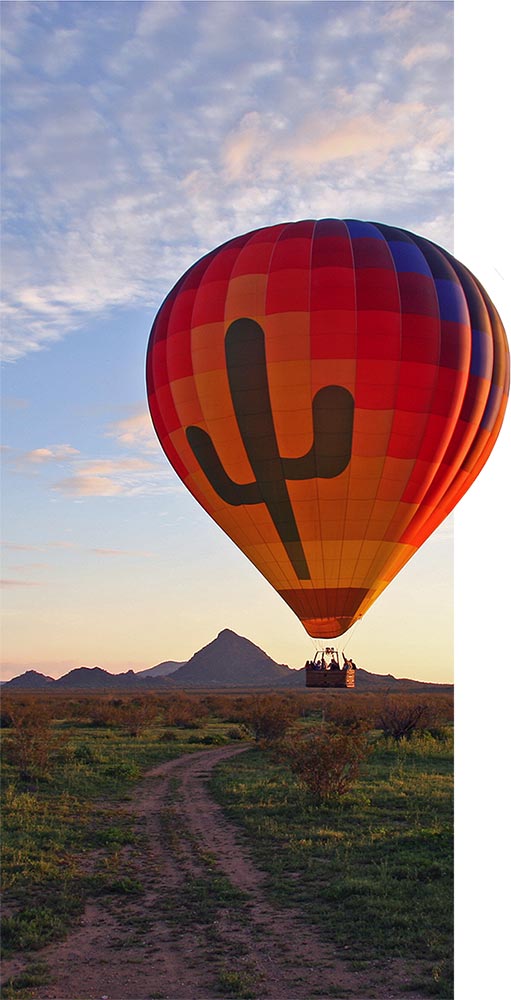



Setting in the Phoenix Area
Tempe is an inner suburb, sitting between the core city of Phoenix and the rest of the East Valley. Mesa is on its east, Scottsdale and the Salt River Pima-Maricopa Indian Community to the north and Chandler to the south. The landlocked city covers 40.2 square miles. The Salt River runs west through the northern part of town and is dammed in two places to create Tempe Town Lake. The land is generally flat except for Tempe Butte, also called Hayden Butte. Elevation runs from 1,140 feet at the lake to 1,495 feet on top of the butte.
History and landmarks
The Hohokam lived here and built canals to support their farming. After Fort McDowell was established northeast of here in 1865, settlers came: "Hayden's Ferry," named for a ferry service on the river, was one of the first permanent communities in the Valley after the fall of the Hohokam. The Tempe Irrigating Canal Company, started by William Kirkland and James McKinney, followed. The name Tempe was adopted in 1879; it compares the valley to the Vale of Tempe near Mount Olympus in Greece, and Darrell Duppa is credited with suggesting it.
Tempe's history includes a hard chapter. For about 90 years from 1871, it was a sundown town where African Americans were allowed to work but forced to live elsewhere. In 1965 Warren and Carol Livingston were the first African Americans to buy property in Tempe.
In 1885 Tempe was chosen as the site of the Territorial Normal School, the origin of Arizona State University. The Maricopa and Phoenix Railroad crossed the Salt River here in 1887, the completion of Roosevelt Dam in 1911 guaranteed enough water for Valley farmers, and Tempe became an economic hub for the farming area around it. Today it is a center of education and commerce, and the city is home to the main campus of Arizona State University.
Work, school and getting around
Dense development in north Tempe has grown up around the Valley Metro light rail line. The Census lists the Tempe Union High School, Tempe Elementary, Kyrene Elementary, Mesa Unified and Scottsdale Unified districts as serving parts of the city. Tempe has the shortest commute of the ten communities, 20.9 minutes on average, and 21.2% of workers work from home. A tornado rated F2 injured 41 people in 1971, one of the rare storms on Tempe's record.
What it is like
Tempe is a college town. The median age is 30.0, the lowest of the ten communities, and only 14.1% of residents are under 18. Half of adults (50.0%) hold a bachelor's degree. The 2020 census counted 180,587 people; the 2024 Census estimate is 188,065.
Homes and housing
Tempe is the only one of the ten where most households rent: just 42.3% own their homes. The median rent is $1,743 and the median home value is $455,400. The median home was built in 1984, the city has about 78,000 households with an average of 2.3 people each, and median household income is $79,663 (2024 American Community Survey figures).
Sources: Tempe, Arizona (Wikipedia, CC BY-SA); U.S. Census Bureau, American Community Survey 2024