
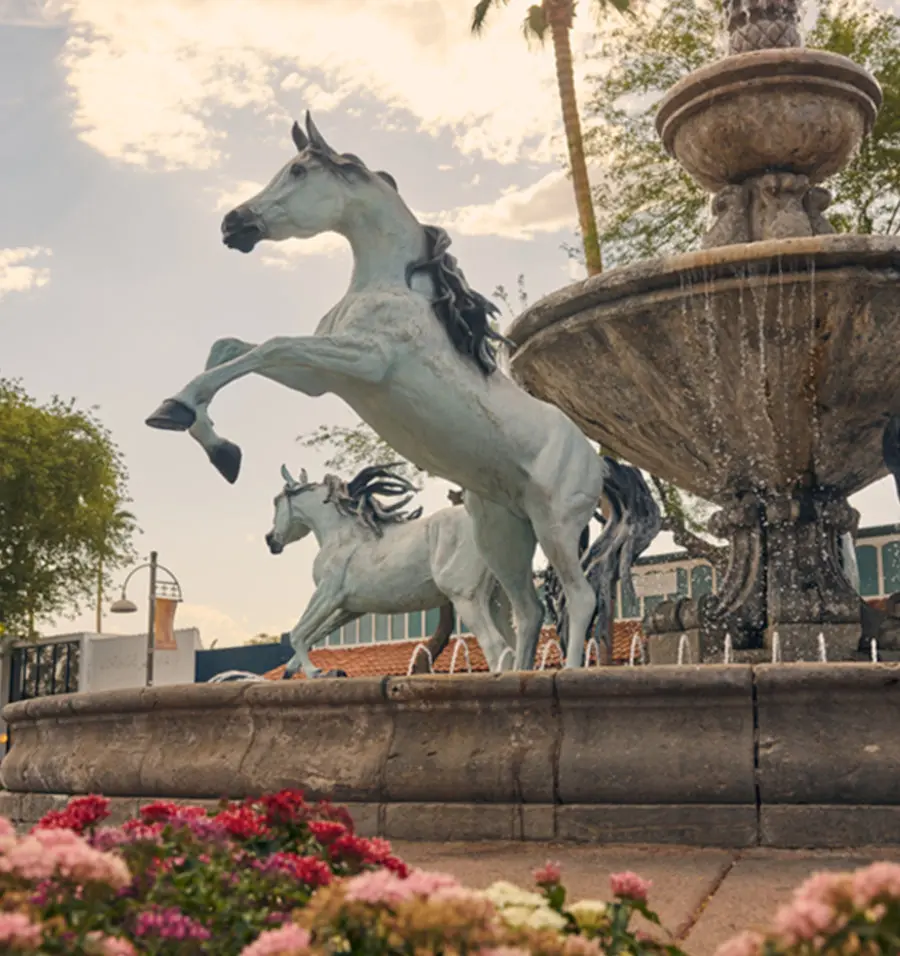



Setting in the Phoenix Area
Phoenix is the capital and most populous city of Arizona. With more than 1.6 million residents at the 2020 census it is the fifth-most-populous city in the United States, and it is the county seat of Maricopa County in the Salt River Valley, a metro area known as the Valley of the Sun. Scattered, low mountain ranges surround the valley. The ground is flat, which lets the main streets run on a precise grid, and the city sits at a mean elevation of 1,086 feet in the northern Sonoran Desert. It gets 3,872 hours of bright sunshine a year, more than any other major city on Earth.
History and landmarks
The Hohokam people lived in the area for 2,000 years. Phoenix was settled in 1867 as an agricultural community, and its story begins with Jack Swilling, a Confederate veteran of the Civil War. The name Phoenix was chosen because it described a city born from the ruins of a former civilization. The city was incorporated in 1881 with a mayor and four council members. The territorial capital moved from Prescott to Phoenix in 1889, the Santa Fe, Prescott and Phoenix Railway arrived in 1895, and on February 14, 1912 Phoenix became a state capital when Arizona joined the Union as the 48th state. In 1913 it adopted a council-manager government, one of the first cities in the country to do so. The city bought Sky Harbor Airport in 1935 and still runs it.
Growth came in waves. Cotton, cattle, citrus, climate and copper were the Five C's that anchored the early economy. After the war Motorola chose Phoenix for a military electronics research center, Intel and McDonnell Douglas followed, and tourism became the third-largest industry by the end of the 1960s. Phoenix got an NBA franchise in 1968, the Suns, and Symphony Hall opened in 1972. The city went from just over 65,000 residents in 1940 to the fifth most populous in America by 2020, and geographers use Phoenix as a textbook case of urban sprawl.
Work, school and getting around
The city's own facts page lists 325 public schools and 41,000 acres of desert parks and mountain preserves. The city is divided into 15 urban villages, each with its own planning area, and locals use names like Downtown, Midtown and Uptown. The city holds the APS Electric Light Parade each December, now in its 39th year. For taxes, utilities and getting around, see the guides elsewhere on this site.
What it is like
The 2024 Census count is 1,642,323 people. The median age is 34.9, 42.0% of residents are Hispanic, and 33.6% of adults hold a bachelor's degree. The average commute is 25.6 minutes, and about one in five workers (19.0%) works from home.
Homes and housing
The median home in Phoenix was built in 1985, and 57.3% of households own their homes. The median home value is $420,700 and the median rent is $1,582. The city has about 610,000 households with a median household income of $81,332 (2024 American Community Survey figures).
Sources: Phoenix, Arizona (Wikipedia, CC BY-SA); City of Phoenix: City History; City of Phoenix: Facts and Statistics; U.S. Census Bureau, American Community Survey 2024