



Understanding Houston
Houston is the most populous city in Texas and the Southern United States, located near Galveston Bay and the Gulf of Mexico.
Where Houston is
Houston is in Southeast Texas near Galveston Bay and the Gulf of Mexico. It is located along the upper Texas Gulf Coast, approximately 50 miles northwest of the Gulf of Mexico at Galveston. The city is 165 miles east of Austin, 250 miles south of Dallas, and west of the Louisiana border.
The city was founded at the confluence of Buffalo Bayou and White Oak Bayou, a point now known as Allen’s Landing. Houston also functions as the southeastern anchor of the Texas Triangle megaregion, which also includes the Dallas–Fort Worth metroplex, Greater Austin, and Greater San Antonio.
Size, counties, and government
Houston had a population of 2.3 million at the 2020 census. The Greater Houston metropolitan area has 7.8 million residents, making it one of the nation’s largest metropolitan areas. The city covers a total area of 640.4 square miles and is the largest U.S. city whose municipal government is not consolidated with a county, parish, or borough.
Houston is the county seat of Harris County. Although the city is primarily located within Harris County, portions extend into Fort Bend and Montgomery counties. Houston was incorporated as a city in 1837, adopted a ward system of representation shortly afterward, and later moved to its existing mayor–council government. The original wards are the predecessors of today’s geographically oriented Houston City Council districts.
Bayous, flat land, and flood patterns
Most of Houston is on the Gulf Coastal Plain. Much of the city was built on forested land, marshes, swamps, or prairie, and these landscapes are still visible in surrounding areas. Houston’s topography is very flat, and Downtown stands about 50 feet above sea level.
Houston has four major bayous passing through the city that accept water from the extensive drainage system. Buffalo Bayou runs through Downtown and the Houston Ship Channel. White Oak Bayou runs through the Houston Heights area toward Downtown, Brays Bayou runs along the Texas Medical Center, and Sims Bayou runs through the south of Houston and Downtown Houston. The ship channel continues past Galveston and into the Gulf of Mexico.
Reading the cityscape
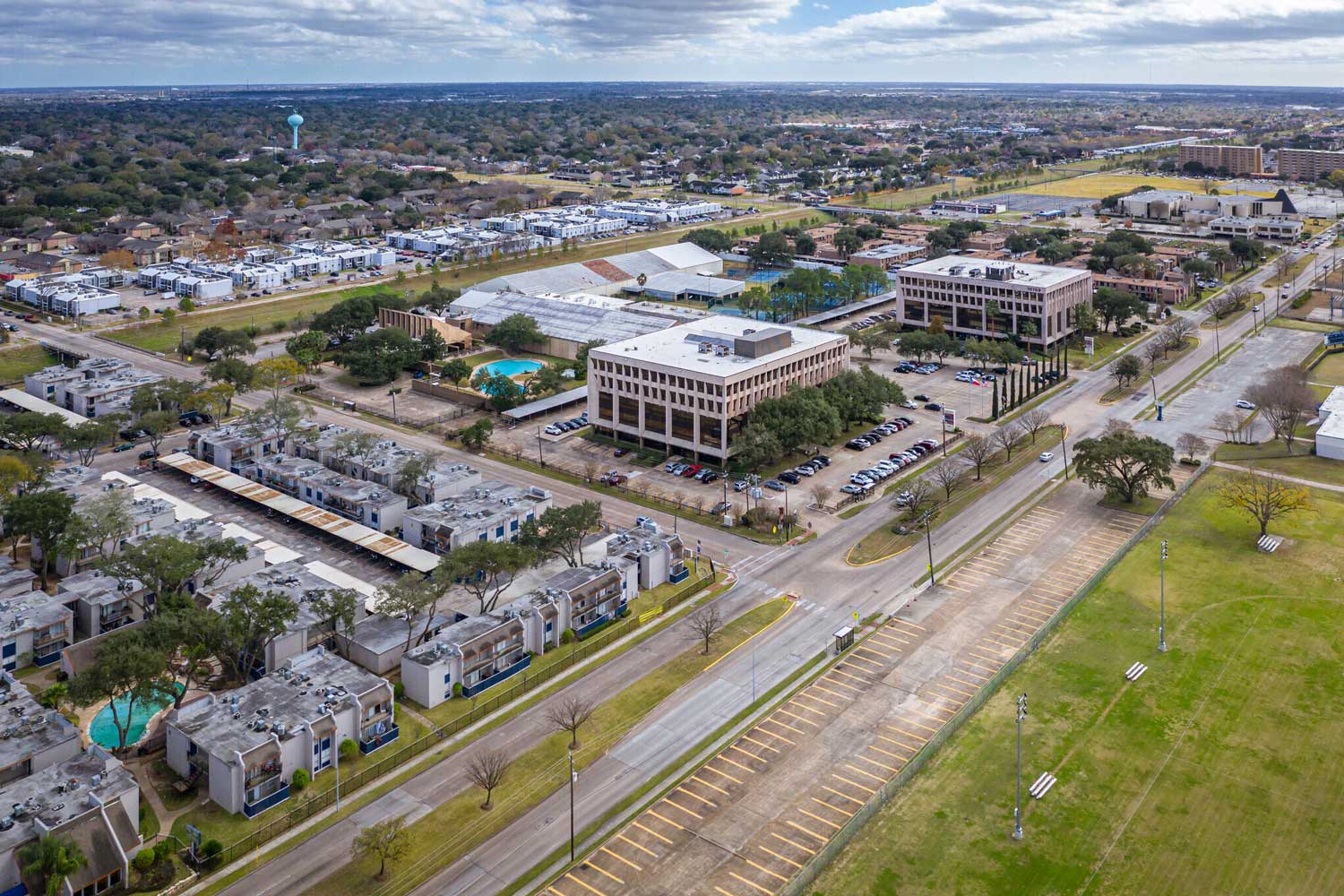
Locations in Houston are generally classified as either inside or outside Interstate 610, also called the 610 Loop or simply the Loop. The Inner Loop includes Downtown, pre–World War II residential neighborhoods, streetcar suburbs, and newer high-density apartment and townhouse developments. Outside the Loop, the city’s form is more suburban, though several major business districts are outside the urban core.
Houston does not have a single central business district as its only employment center. Multiple districts and skylines have grown throughout the city in addition to Downtown, including Uptown, the Texas Medical Center, Midtown, Greenway Plaza, Memorial City, the Energy Corridor, Westchase, and Greenspoint.
The area around Houston
Greater Houston, designated as Houston–Pasadena–The Woodlands, encompasses ten counties along the Gulf Coast in Southeast Texas. The metropolitan region centers on Harris County and includes urbanized areas built on former forested land, marshes, swamp, or prairie, with remnants still visible around the region.
The wider area is crossed by creeks and bayous that provide drainage during rainfall events. Notable waterways include Buffalo Bayou, White Oak Bayou, Brays Bayou, Spring Creek, and the San Jacinto River. Regional features include the Katy Prairie to the west, the Big Thicket to the northeast, and the Galveston Bay ecosystem to the south.