Sustainability Is More Than a Buzzword for Napa Valley's Winemakers Page 1 of 2
In Napa Valley, sustainability has evolved from a niche aspiration into a central ethos for many winemakers. It’s no longer about checking a box or following a trend. For a growing number of wineries, it’s a guiding principle that shapes every decision—from vineyard practices to packaging choices, and from community engagement to long-term stewardship of the land. It’s about keeping the valley’s beautiful landscape vibrant and productive for generations to come while producing wines that reflect not just terroir, but responsibility.
Ask a Napa winemaker to define sustainability, and you’ll hear answers that go beyond environmental protection. The conversation often begins with soil and water, the raw materials of wine, but quickly extends to biodiversity, climate action, energy use, packaging, labor welfare, and community engagement. Here, sustainability is as much about social responsibility as it is about ecological stewardship. In practice, this means thinking in decades, not vintages. A sustainable approach considers the long-term health of the land, the people who work it, and the community it supports. It’s not just avoiding harm, but actively creating conditions where all can thrive.
One illustrative example comes from Clif Family Winery & Farm. Their CCOF-certified organic vineyards avoid synthetic pesticides and fertilizers, focusing instead on living ecosystems that support soil health, bees, and birds. Regenerative practices like pollinator habitats, cover cropping, and composting enrich the land while minimizing waste. Sustainability extends beyond the vineyard: lighter-weight glass, non-toxic inks, reusable kegs, and careful consideration of packaging reflect a commitment to reducing carbon emissions.
“Sustainability isn’t a department at Clif Family—it’s the backbone of the entire business,” says Linzi Gay, President of Clif Family Winery & Farm. “Every decision, whether it’s how we grow grapes or how we ship wine, reflects our values. We’re constantly asking: how can we do better for the planet, our community, and future generations? That mindset isn’t just good for the world; it makes us a stronger, more resilient company.”
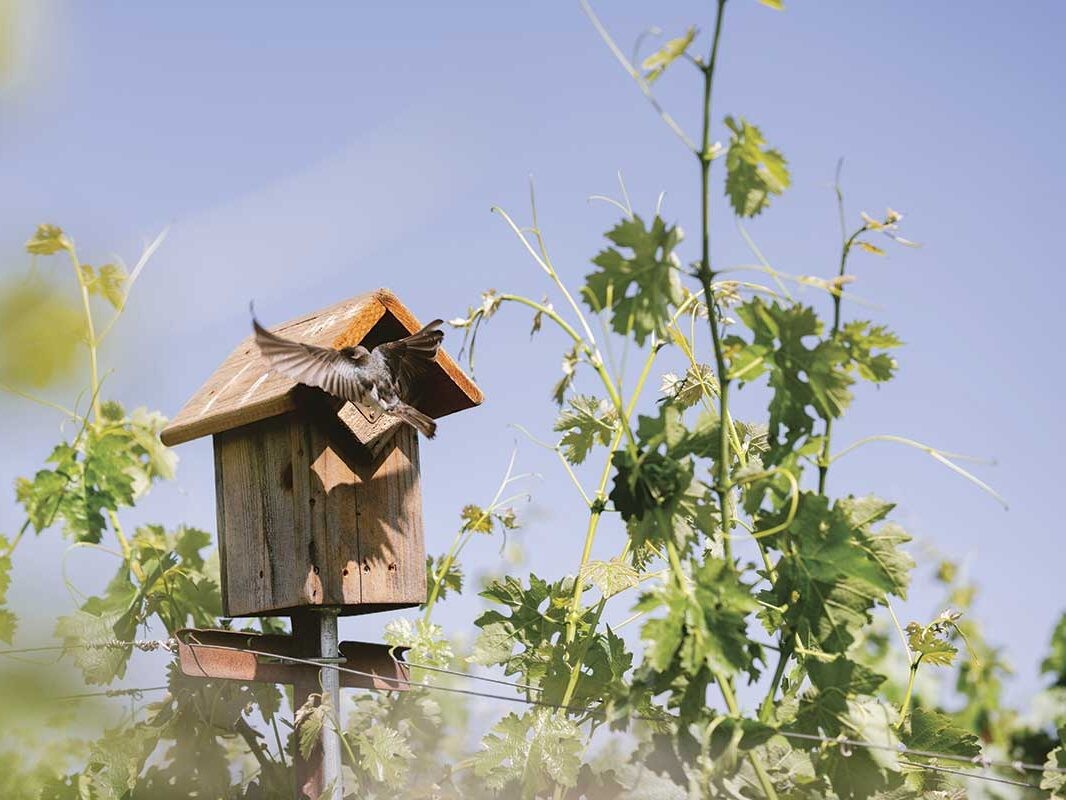
Photo courtesy of Sequoia Grove
The vineyard is the heart of any sustainability effort. Napa’s winemakers have increasingly embraced methods like organic and regenerative farming, which focus on building soil health rather than simply treating problems as they arise. Cover crops, from mustard to clover, help prevent erosion, fix nitrogen, and provide habitat for beneficial insects. Integrated Pest Management (IPM) minimizes chemical use by relying on natural predators and targeted interventions.
Many vineyards also maintain buffer zones of native plants to support pollinators and wildlife, a strategy that doubles as a defense against erosion during heavy rains. Drip irrigation systems and moisture sensors reduce water use—an increasingly urgent concern as drought cycles lengthen. On some estates, sheep graze between the vines, reducing the need for mowing and returning nutrients to the soil. These visible measures are just part of a larger system designed to keep the vineyard in balance with the surrounding ecosystem.
Sequoia Grove in Rutherford offers a compelling example of sustainability in action. Here, the presence of ancient redwoods is more than symbolic—it informs the winery’s long-term approach. The winery integrates sustainability throughout every aspect of its operations, from precision irrigation and soil-specific cover crops in the vineyards to energy-efficient lighting and cellar systems. Its Napa Green Winery & Vineyard certification underscores the winery’s commitment to climate action, water efficiency, soil health, and social equity. Sequoia Grove also runs on 100% renewable electricity by opting into MCE’s Deep Green program and participates in the 1% for the Planet initiative, donating a portion of revenue to environmental nonprofits including the Save the Redwoods League.
Sustainability doesn’t stop at harvest. Once grapes reach the winery, resource management shifts to energy, water, and waste. Many Napa wineries have installed solar arrays, harnessing California’s abundant sunshine to power operations. Energy-efficient lighting and climate control systems reduce electricity use without compromising wine quality. Water recycling is another cornerstone. After cleaning equipment and barrels, wastewater can be treated and reused for irrigation. Some wineries capture and store rainwater for non-potable uses, easing the strain on municipal supplies.